Training Paramedics for Chaos: Stress Inoculation in EMS
Training for Chaos: Stress Inoculation and High-Performing EMS Systems
Emergency medical services professionals routinely enter environments defined by uncertainty. The information is incomplete, resources may be limited, and the patient’s condition can change in seconds. In those moments, technical knowledge matters—but so do composure, communication, clinical judgment and the ability to lead.
In this episode, nationally registered paramedic and certified flight paramedic Sam Oxford shares lessons from a career spanning ground EMS, critical care transport, flight medicine, clinical operations and education. His experience offers a practical look at how paramedics can prepare for high-stakes calls and how EMS organizations can build teams capable of consistently delivering excellent care.
Paramedic School Is the Starting Point
Early in his career, Sam responded to a woman who said she simply did not feel well. She was standing in her driveway and initially appeared stable enough to walk toward the ambulance. Within moments, however, her condition deteriorated. She became diaphoretic, struggled to breathe and had an oxygen saturation in the 70s. Sam could not obtain a blood pressure, and the patient would not tolerate oxygen, CPAP or other interventions.
Only six months out of paramedic school, Sam felt helpless. At the hospital, the emergency department team recognized flash pulmonary edema and immediately began treatment. Watching them work forced Sam to confront an uncomfortable truth: passing paramedic school had prepared him to begin practicing, but it had not prepared him for every situation he would encounter.
That call became a turning point. Instead of hiding from the experience, Sam continued to examine it. He recognized that he had not completed a thorough initial assessment or obtained vital signs before moving the patient. He began approaching subsequent calls with greater humility and curiosity.
The lesson is not that new paramedics should already know everything. It is that they must recognize how much remains to be learned. Entry-level education establishes a foundation. Competence develops through experience, continued study, deliberate practice and honest reflection.
Learning Through Debriefing
Every call presents an opportunity to improve, but experience alone does not guarantee growth. Clinicians must be willing to examine their decisions.
A debrief does not always require a formal meeting with supervisors or medical leadership. It can be a short conversation between partners after a call: What went well? What could we have done differently? Why did we choose that treatment? Did we miss anything?
These discussions help identify knowledge gaps before they become habits. They also normalize the reality that even experienced clinicians make mistakes. The goal is not to eliminate accountability or excuse poor performance. It is to create an environment in which people can acknowledge errors, understand their causes and avoid repeating them.
This kind of open communication became a routine part of Sam’s experience in flight medicine. After a transport, the flight medic, nurse and pilot would discuss their decisions. Team members could question a medication choice, ventilator adjustment or flight plan without automatically turning the conversation into an accusation.
That openness builds trust. Clinicians become more confident that colleagues will speak directly to them, while the team becomes more capable of correcting problems before the next patient encounter.
Stress Inoculation for Paramedics
Remaining calm under pressure is not simply an instinct that some people possess and others do not. It is a skill that can be developed.
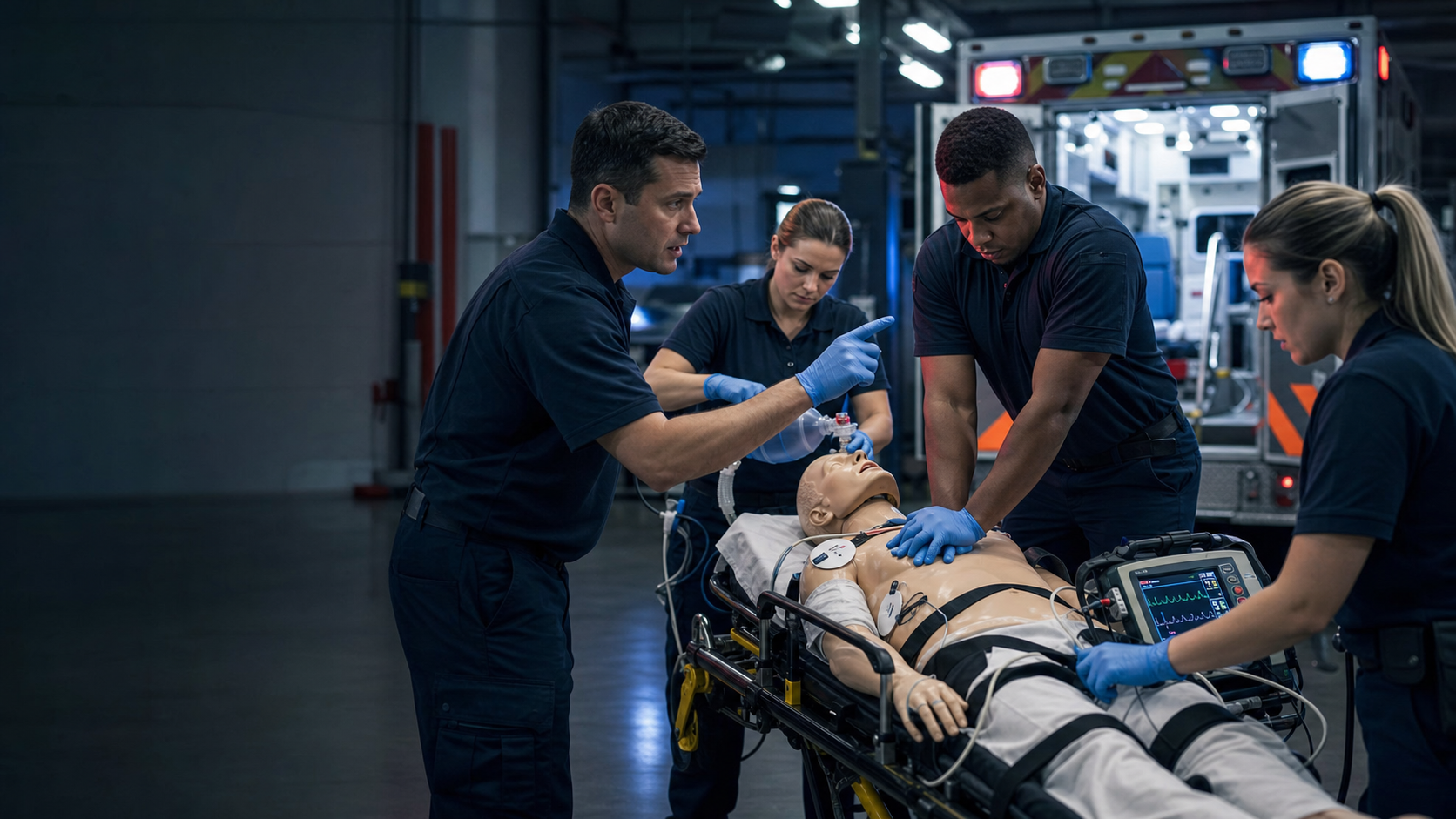
Sam uses stress inoculation to help clinicians become more comfortable in difficult situations. The concept involves exposing participants to controlled stress during realistic simulations. Their heart rate rises, they experience cognitive overload, and they must still assess the patient, manage resources and make decisions.
The exercise is challenging by design, but it occurs in an environment where mistakes become learning opportunities. After several scenarios, participants often become more composed and confident. They understand the simulation cannot harm them, learn to manage their physiological response and become better at connecting their clinical knowledge with physical action.
An effective simulation program does not necessarily require a six-figure training laboratory. Portable monitors and relatively simple equipment can support short scenarios inside an ambulance or at a fire station. A five-minute cardiac arrest exercise before a shift can expose problems with equipment familiarity, communication, pulse checks or compression interruptions.
Simulation also gives educators valuable information. If several crews struggle with the same decision or skill, the problem may not rest with one clinician. It may reveal an organizational training gap that deserves attention.
Reducing Cognitive Overload
One of the easiest ways to improve performance under pressure is to master the basics before the call begins.
Providers should know where equipment is stored, how it operates and whether it is ready for use. Searching for a CPAP device, glucometer or airway tool during a critical call consumes time and mental capacity. The same is true of medication preparation and unfamiliar monitoring equipment.
Team familiarity matters as well, but EMS professionals cannot expect to work only with people they know. They may need to coordinate with an unfamiliar fire crew, law enforcement officers or hospital staff. That requires clear directions and closed-loop communication.
During a procedure such as rapid sequence intubation, every team member should know what has been requested, whether the request was heard and when the task was completed. Announcing that a medication has been administered or confirming that equipment is ready keeps the team synchronized and prevents critical actions from remaining in limbo.
With practice, this coordination can begin to resemble choreography. That level of performance is not accidental. It grows from repetition, shared expectations and trust.
Clinical Judgment Beyond the Protocol
Protocols are essential, but patients do not always fit neatly within them. A single patient may present with several competing conditions or fall between established treatment categories.
Sam offers the example of a patient who achieves return of spontaneous circulation after cardiac arrest. The patient has an endotracheal tube in place and begins waking up. If the EMS system does not have a specific post-intubation sedation protocol, the clinician must still address pain, agitation and the risk of the patient removing the airway.
The answer begins with a complete assessment and reliable vital signs. From there, the paramedic must identify the patient’s needs, determine which available guidelines apply and choose the most appropriate treatment. Most importantly, the clinician must be able to explain the reasoning behind that decision.
Documentation is a critical part of this process. A good patient care report does more than list treatments. It records relevant findings, explains why interventions were chosen and supports continuity of care. When a clinician must adapt a guideline to a complicated patient, clear documentation shows that the decision was thoughtful rather than arbitrary.
Why Cardiac Arrest Survival Varies
Cardiac arrest provides a powerful example of how system performance affects patient outcomes. The patient’s initial rhythm matters, but geography can matter too. Some communities have developed coordinated systems that emphasize early CPR, rapid defibrillation and consistent execution across dispatchers, law enforcement, fire departments and EMS.
High-performing systems focus relentlessly on the fundamentals. During a cardiac arrest, high-quality compressions and early defibrillation for a shockable rhythm are essential. Long pauses in compressions reduce the patient’s chance of survival.
Seemingly minor operational adjustments can shorten those pauses. Crews can pre-charge the defibrillator before a rhythm check, establish hand placement for a pulse check in advance and have the compressor hover over the patient’s chest, ready to resume immediately. These steps can turn a prolonged interruption into one lasting only a few seconds.
Improvement also requires measurement. Reviewing monitor data can reveal pauses that might otherwise go unnoticed. The purpose should be to improve performance, not punish clinicians for every imperfection. When organizations examine the data, train around recurring problems and repeat the process, better resuscitation becomes a system expectation rather than an individual achievement.
Building High-Performing EMS Teams
A collection of capable clinicians does not automatically become a high-performing team. Strong teams share standards, communicate openly and hold one another accountable.
Credible leadership combines support with expectations. A good leader is approachable when an employee needs help, but is also willing to address recurring problems. Accountability does not mean destroying someone over a mistake. It means identifying the issue, understanding what is contributing to it and helping the person improve.
Organizations must also create reasons for excellent paramedics to remain engaged in clinical care. Traditional EMS career progression often pushes people toward supervision if they want greater responsibility or compensation. Clinical specialist, educator and advanced-response roles can provide another path for professionals who want to grow without leaving the field.
When these positions have meaningful selection standards, education and responsibilities, clinicians value them. Team members begin holding themselves accountable because they respect the role and what it represents.
The larger lesson from Sam’s career is that excellent EMS performance does not begin when the tones drop. It begins with preparation, practice, humility and culture. Clinicians who train under pressure are better equipped to think under pressure. Teams that communicate honestly are more likely to trust one another. Systems that measure performance can identify where improvement is needed.
Chaos may be unavoidable in EMS. Being unprepared for it is not.

Host
Jason Falvey, NRP, is an EMS Battalion Chief and the creator and host of the In-Service EMS Podcast. With more than 30 years in emergency medical services, he has built a career spanning frontline paramedicine, clinical quality, countywide operations, regulatory compliance, business development, and executive leadership across multiple states.
Jason’s experience in high-stakes environments began well before his EMS career. As an accomplished sailor and divemaster, he participated in underwater search-and-recovery and salvage operations in the North Atlantic. That perspective now informs In-Service, where he brings EMS professionals together for candid conversations about leadership, clinical judgment, innovation, workplace culture, and the realities of prehospital care.
Flight Paramedic & Helicopter EMS: What Every EMS Provider Should Know